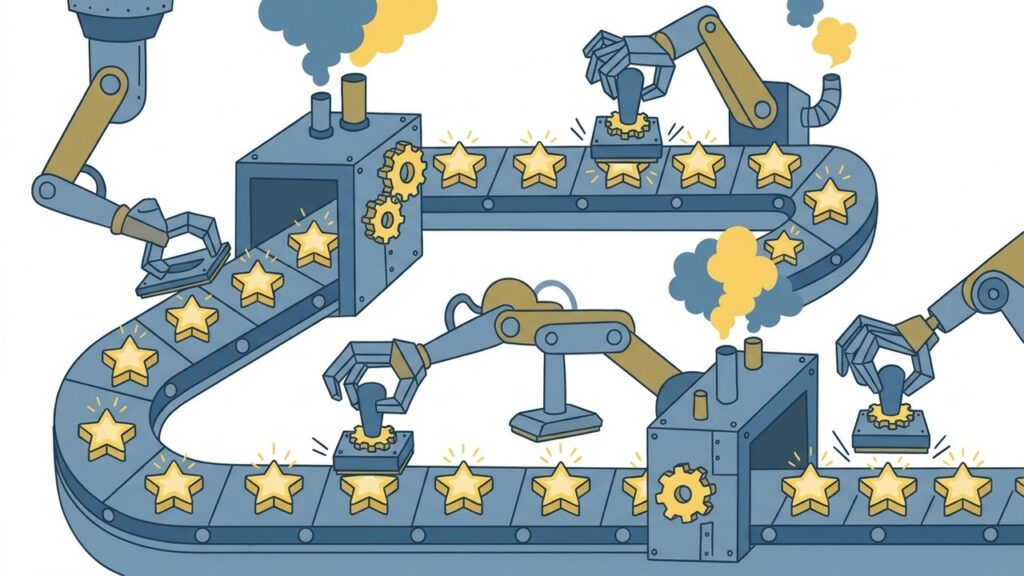
Researchers estimate that between 30 and 40 percent of all online product reviews are fake. That four-point-eight-star rating you are about to trust? It may have been purchased in bulk from a review farm. The glowing testimonials on that unfamiliar store? Possibly written by software, posted by paid accounts, and verified by no one.
Fake reviews are not just misleading – they are one of the primary tools that scam stores use to appear legitimate. Here is how to see through them.
How Fake Review Operations Work
The fake review industry is sophisticated. Operations range from simple paid-posting schemes – sellers paying individuals to post positive reviews in exchange for a free product or cash – to fully automated systems using AI-generated text posted through networks of fake accounts.
Some sellers use a technique called “review hijacking”: they list their product under an existing ASIN (Amazon’s product identifier) that already has thousands of legitimate reviews, then quietly change the product. The reviews stay; the product changes.
On independent stores, the entire review section may be invented from scratch with no real customers involved at all.
Warning Signs of Fake Reviews
The timing pattern. Legitimate products accumulate reviews gradually over months and years. A product with 400 five-star reviews, all posted within a two-week window, was not reviewed by real customers.
The language pattern. Fake reviews often use suspiciously similar phrasing, unusually formal language, or repeat the same product name and features in a way that sounds promotional rather than conversational. Read ten reviews out loud and notice whether they feel like real people talking.
The rating distribution. Genuine products show a natural spread of ratings – even exceptional products have some one and two-star reviews from customers with specific complaints. A product with 98 percent five-star ratings and no criticism whatsoever is statistically improbable.
The reviewer profiles. Click on reviewer profiles. Legitimate customers have review histories across different product categories and time periods. Fake accounts often have no profile photo, review only one or two products (all five stars), and were created recently.
The verified purchase badge. On platforms like Amazon, look for “Verified Purchase” labels. Non-verified reviews can be posted by anyone – including sellers themselves. A section full of non-verified reviews with no verified ones is a warning sign.
Tools That Can Help
Several browser extensions analyse review patterns automatically and flag suspicious distributions. Fakespot and ReviewMeta are widely used for Amazon and a number of other platforms. They assign grades based on review authenticity signals and highlight reviews that may have been artificially generated.
For independent stores, these tools have limited reach – which is where broader website trust checks become essential.
Which Platforms Are Most Affected
Amazon remains the largest battleground for fake reviews due to its scale, but the problem is widespread across Etsy, AliExpress, Wish, and many independent Shopify stores. Any platform where sellers benefit directly from review counts and ratings is a target.
Reviews on a store’s own website, with no independent verification system, should be treated as marketing copy rather than customer feedback.
Cross-Reference Before You Buy
The most reliable defence is to check reviews in multiple places. If a product has thousands of glowing reviews on its own website but almost no presence on Reddit, YouTube, or independent review sites, that asymmetry tells you something. Real products that people genuinely love get talked about spontaneously in places the seller cannot control.
Before buying from any unfamiliar store, run a quick check with ShieldFlag. In addition to catching fake review patterns, ShieldFlag scans for domain age, blacklist records, SSL issues, and other signals that reveal whether a site is trustworthy – so you are not relying on star ratings that may have been manufactured from the start.